
Shopify still leads the hosted e-commerce market. It captures roughly 30% of the U.S. e-commerce platform market and powers millions of live stores worldwide, according to DemandSage. But "biggest" isn't the same as "best fit for you." Between rising app costs, transaction fees on non-Shopify-Payments orders, and 2026 pricing changes rippling across the industry, more merchants are actively comparing alternatives before they build.
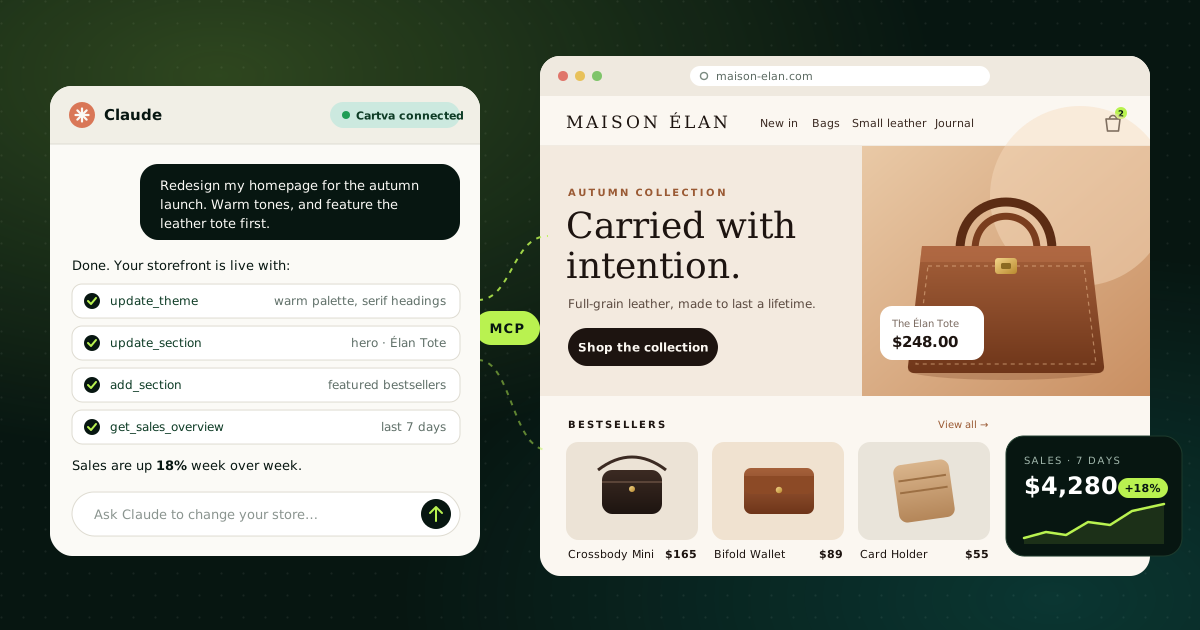
This guide breaks down 6 real Shopify alternatives for 2026: what they cost, where they charge extra, and who they're actually built for. The list includes Cartva, a newer all-in-one platform that acts as Merchant of Record, so you can sell without registering a company, with print-on-demand and dropshipping built in.
Why merchants are looking for a Shopify alternative in 2026
A few recurring pain points show up across comparison sites and reviews:
- Transaction fees stack up. Unless you use Shopify Payments, Shopify still charges an extra fee on every order processed through a third-party gateway.
- The app tax. Core features like reviews, upsells, loyalty, and advanced SEO often live behind paid apps, and those subscriptions add up fast on top of the plan fee.
- Checkout customization is gated. Deep checkout control is limited to the highest (Plus) tier, which starts in the thousands per month.
- Competitors are adjusting pricing too. BigCommerce's 2026 update introduced a new "Open Payment Provider" fee for merchants who don't use an approved gateway. It's a reminder that every platform's fee structure is worth re-checking yearly, not just Shopify's.
None of that makes Shopify a bad platform. It just means the "default" choice isn't automatically the cheapest or the best match for every business model.
The 6 best Shopify alternatives in 2026, at a glance
| Platform | Free plan | Starting price (billed annually) | Platform transaction fee | Best for |
|---|---|---|---|---|
| WooCommerce | Software is free (hosting not included) | ~$0 + ~$8–15/mo hosting | 0% (WooCommerce itself) | Full control on your own WordPress site |
| BigCommerce | No | $29/mo (Core) | 0% with an approved gateway; up to 2% otherwise | Scaling B2B and multi-storefront brands |
| Wix | Yes (no store on the entry plan) | $29/mo (Core) | 0% | All-in-one website + store for services |
| Squarespace | No | $16/mo (Basic, 2% fee) or $23/mo (Core, 0% fee) | 2% on Basic, 0% on Core and up | Design-led brands and creators |
| Square Online | Yes | $0 (Free plan) | 0% platform fee; 3.3% + $0.30 processing on Free | Retailers already using Square POS |
| Cartva | No (30 days free, no card required) | $15/mo (Solo; $19/mo billed monthly) | 9% on Solo, 7% on Grow, 6% on Enterprise, card processing included | Sellers without a company who want print-on-demand + dropshipping built in |
1. WooCommerce
WooCommerce is a free plugin that turns a WordPress site into a store. It's open-source and self-hosted, and measured by number of live stores it remains one of the most widely used e-commerce systems on the web.
Strengths: total control over code and design, a massive plugin ecosystem, no platform lock-in.
Weaknesses: "free" is misleading. Once you add hosting ($8–15/mo), a decent theme, and the paid extensions most stores end up needing, realistic budgets land around $250–500/year. Setup and maintenance (security updates, plugin conflicts) are on you.
Best for: merchants who already know WordPress, or have a developer on hand and want full ownership of their store's code.
2. BigCommerce
BigCommerce is the strongest hosted alternative for stores planning to scale into serious volume. As of its 2026 pricing update, plans were renamed Core ($39/mo, $29/mo billed annually), Growth ($105/mo, $79/mo annually), and Scale ($399/mo, $299/mo annually).
Strengths: native B2B tools (company accounts, price lists, quoting), multi-storefront support without extra apps, and 0% transaction fees if you use one of its approved payment providers.
Weaknesses: each plan has an annual revenue cap, and crossing it auto-upgrades you to the next tier's price. Use a non-approved payment gateway and a new "Open Payment Provider" fee (2% down to 0.6% depending on plan) applies on top of standard card processing.
Best for: growing B2B or wholesale-heavy businesses that will outgrow a simple storefront.
3. Wix
Wix started as a general website builder and added strong commerce tools on top. The Core plan ($29/mo annually) unlocks selling, and Business ($39/mo annually) adds multi-currency and expanded shipping.
Strengths: the easiest drag-and-drop editor of the group, native booking tools alongside product sales, and 0% Wix transaction fees (you still pay standard payment-gateway processing, ~2.9% + $0.30).
Weaknesses: built more for content-and-commerce hybrids than large catalogs. It's less suited to stores selling hundreds of SKUs or needing deep inventory logic.
Best for: service businesses and small catalogs that want a polished website and a store in one place.
4. Squarespace
Squarespace is best known for template quality. Plans run Basic ($16/mo), Core ($23/mo), Plus ($39/mo), and Advanced ($99/mo), all billed annually. The entry Basic plan still carries a 2% Squarespace fee on sales; Core and above waive it.
Strengths: genuinely best-in-class design templates, strong for brand-forward and portfolio-style stores.
Weaknesses: fewer commerce-specific features and third-party apps than Shopify or BigCommerce, and checkout customization is more limited.
Best for: creatives, artists, and design-conscious brands where the storefront itself is part of the pitch.
5. Square Online
Square Online is the natural pick if you already run Square in a physical location. It has a genuine Free plan, plus Plus ($49/mo) and Premium ($149/mo) tiers.
Strengths: built-in sync between in-person POS and online orders, so inventory, customers, and reporting stay in one place. No monthly cost required to start selling.
Weaknesses: on the Free plan, online card processing runs higher (3.3% + $0.30) than Plus/Premium (2.9% + $0.30), and marketing/content tools are lighter than dedicated e-commerce platforms.
Best for: retailers, cafés, and pop-up sellers who need online and in-store sales in sync.
6. Cartva
Cartva takes a different starting point: it is the Merchant of Record for every store. Cartva is the legal seller at checkout, so it processes card payments, covers chargebacks and handles payment compliance. You don't need a registered company, an LLC, or a Stripe or PayPal account in your own name. You verify your identity once, before your first withdrawal. (More on how that works in Merchant of Record for online stores.)
Plans: Solo is $19/mo, Grow is $49/mo, and Enterprise is $99/mo, or $15, $39 and $79/mo billed annually. Every store gets 30 days free without a card, then starting a plan costs $1 for the first month before the regular price. Cancel anytime. See the full breakdown on the Cartva pricing page.
Strengths:
- One fee per sale, card processing included: 9% on Solo, 7% on Grow, 6% on Enterprise, with a $0.30 minimum per order. Nothing is added on top, and cash on delivery is always 0%. A 5% reserve is held on each sale to cover disputes.
- Print-on-demand and dropshipping are built in on every plan, not bolted-on apps: print-on-demand without connecting a supplier, and dropshipping imports from CJ Dropshipping and Doba. (If you're new to the model, see how to start print on demand in 2026.)
- AI store builder: describe a page and it builds it, with 1M to 20M AI tokens a month depending on the plan.
- Withdrawals from $10, and a store can go live the same day with no code.
Weaknesses: a smaller app and theme ecosystem than an incumbent like Shopify, since the platform is newer. The per-sale fee is also higher than raw card processing on platforms where you bring your own payment account: part of it pays for Cartva acting as the legal seller.
Best for: first-time sellers, creators and small brands who want to start selling without registering a company, and who want print-on-demand or dropshipping working out of the box instead of stitching together three app subscriptions.
Which Shopify alternative should you choose?
- You already know WordPress and want full control: WooCommerce.
- You're scaling into B2B or multi-storefront territory: BigCommerce.
- You want an all-in-one website with light e-commerce: Wix.
- Design and brand feel are the priority: Squarespace.
- You run a physical location on Square: Square Online.
- You don't have a company yet and want print-on-demand or dropshipping without extra apps: Cartva.
If you write about ecommerce platforms rather than sell on one, the comparison above is also a monetisable topic: see how recurring commissions work in ecommerce affiliate marketing.
Frequently asked questions
Is there a truly free Shopify alternative?
Yes. WooCommerce's core software is free (hosting isn't) and Square Online has a genuine free plan, though each has trade-offs in fees or features at that tier. Cartva has no free plan, but every store gets 30 days free without a card, then $1 for the first month of any plan.
Which Shopify alternative has the lowest fees?
For platform-level transaction fees specifically, Wix and BigCommerce (with an approved gateway) charge 0%, but you still pay card processing on top. Cartva works differently: one fee per sale (9%, 7% or 6% depending on the plan) that already includes card processing, and 0% on cash on delivery orders.
Can I switch from Shopify without losing my products and orders?
Most alternatives, including Cartva, support importing products from an existing Shopify store. Order history typically stays in Shopify's records unless you export it manually before migrating.
Do I need a company to sell on Cartva?
No. Cartva is the Merchant of Record, so it is the legal seller at checkout and handles payment processing and chargebacks. You don't need a company, an LLC or your own payment account. You verify your identity once, before your first withdrawal.
Start comparing with a real store, not just a demo
The fastest way to know if a platform fits is to build in it. Start your 30-day free trial on Cartva and see your first product live in minutes. No credit card required.
Sources: DemandSage: Shopify Market Share · BigCommerce: 2026 Pricing Update · Squarespace: Shopify Alternatives · Wix: E-commerce Plans · Square: Online Store Plans · WooCommerce